The 2026 Alpha Playbook: Data as the Next Underwritten Asset Class

By Gulp Data
In early 2024, a seemingly minor financial headline sent a major signal to the alternative investment world: Reddit signed a $60 million annual deal to license its user-generated content to Google. For most, it was a tech story about training AI models. For the sophisticated allocator, however, it was a "proof of concept" for a new frontier of alpha.
This transaction signaled a fundamental migration. Data is no longer just an operational "exhaust" or a cost center—it is transforming into a primary, financeable, and underwritten asset class. As we look toward the Uncorrelated Alts conference in Puerto Rico this April 2026, the question for family offices and niche managers is no longer if they should value their data, but how to leverage it for uncorrelated returns.
The Death of the "Free Lunch": From Scraping to Sovereignty
For a decade, the AI revolution was fueled by a "wild west" mentality of free, scraped web data. That window has now slammed shut—both literally and legally. High-profile litigation and the rise of data sovereignty laws have codified what many in the industry already knew: the "free lunch" is over.
While the behavior of buying and selling data has existed since the late 1990s, the current AI arms race has moved these transactions from the back office to the boardroom. Organizations are no longer looking for "public" data; they are hunting for proprietary data—the kind that exists behind paywalls, within private healthcare systems, or tucked away in the historical logs of boutique fund managers. This scarcity is driving a massive acceleration in data-buying behavior, turning once-stagnant companies into high-value targets.
The Clearlake Bridge: Underwriting the "Data Lake"
To see this shift in action, one need only look at Clearlake Capital’s landmark acquisition of Dun & Bradstreet. While D&B is a legacy business information provider with roots stretching back to 1841, Clearlake’s multi-billion dollar bet wasn't just on traditional revenue-multiple stability—it was a strategic move to capture one of the world's most preeminent proprietary datasets for the AI era.
However, Clearlake is far from alone in this "Data-First" underwriting approach. The market is witnessing a concentrated wave of transactions where data and compute capacity are the primary value drivers:
● The Microsoft-Taylor & Francis Deal (2024): In a move that signaled the end of the "free scraping" era, Microsoft paid an estimated $75 million to the academic publisher Informa (parent of Taylor & Francis) specifically for data access to train its AI models. This turned a legacy library of academic journals into a high-margin, liquid licensing asset.
● Thoma Bravo’s Aviation Software Pivot (2025): Thoma Bravo’s $10.5 billion acquisition of specialized aviation software assets from Boeing highlighted a transition toward "Verticalized Data." The play wasn't just about the software's functionality, but the decades of proprietary flight and maintenance data that are indispensable for next-gen aerospace AI.
● Blackstone’s $70B Infrastructure Bet (2025-2026): Blackstone has pivoted its massive real estate engine to become the world’s largest AI infrastructure investor. Through its ownership of QTS Data Centers, Blackstone is essentially "warehousing the world's data," treating digital infrastructure as a core utility with even more predictable appreciation than traditional commercial real estate.
These acquisitions act as a real-world bridge, showcasing that top-tier private equity firms and hyperscalers are no longer just buying companies for their EBITDA; they are underwriting them for their "Data Sovereignty." In the AI era, proprietary records—whether they are centuries of business data from D&B or niche academic research—are being reclassified from "intangible assets" to "senior-secured value."
The "Uncorrelated" Bridge
For the family office and institutional allocator, the allure of data as an asset class isn't just growth—it is the lack of correlation. While traditional equity and credit markets move in lockstep with macro shifts, the value of a proprietary dataset is frequently insulated from interest rate hikes or geopolitical volatility.
Data doesn't trade like a stock. It functions more like a royalty stream or a specialized real asset. By treating data as a distinct pillar of the portfolio, investors can find a hedge that provides yield and appreciation independent of the standard market cycle.
Tactical Execution: The Four Pillars of Data Capital
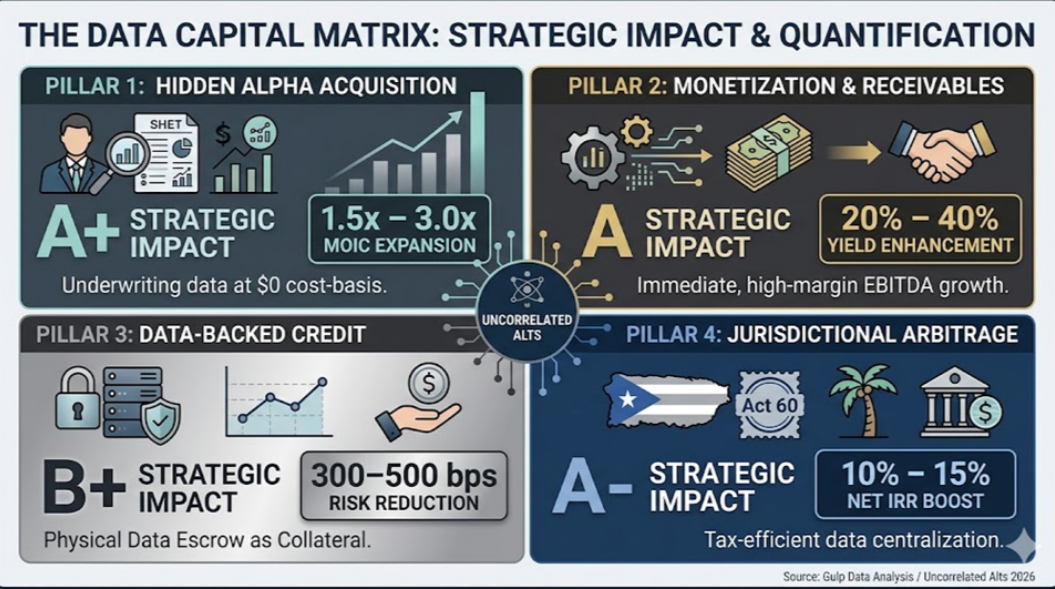
To navigate this shift, allocators must move beyond theoretical appreciation and toward structured deal-making. Below are the four tactical pillars, complete with deal outlines and projected impact for the modern investor.
Pillar 1: Identifying Hidden Alpha in Acquisitions
When reviewing mid-market acquisitions, the traditional "revenue multiple" approach often hides the true potential of the target.
● The Opportunity: Identify legacy firms with "high-fidelity" datasets—long-term customer histories, supply chain logs, or specialized scientific data—that have never been productized.
● The Investor Lens: If the asking price is based solely on a 5x or 8x EBITDA multiple, the data asset is effectively being valued at zero.
● Deal Outline: An investor acquires a specialized logistics firm for its cash flow. Post-acquisition, the investor uses a third-party valuation (such as Gulp Data) to quantify the data asset. By licensing that data to an AI firm, the investor effectively lowers their entry multiple and creates a high-margin revenue stream.
● Strategic Impact: A+
● Projected Alpha Lift: 1.5x – 3.0x MOIC Expansion. By underwriting the data at a $0 cost-basis, you effectively "buy" a second company inside the first, significantly boosting the exit multiple.
Pillar 2: Monetizing and Financing Receivables
Given the nascent awareness of this asset class, there is a massive opportunity to provide liquidity to firms that sit on valuable data but lack the "AI-ready" infrastructure to sell it.
● The Opportunity: Act as the bridge between "Data Owners" and "Data Buyers" (AI labs, hedge funds, or researchers).
● The Investor Lens: Look for companies with highly marketable data assets and broker the licensing deals or, more attractively, provide an advance on the data licensing contract for credit-worthy buyers.
● Deal Outline: A family office identifies a healthcare tech firm with a $10M multi-year data licensing contract from a blue-chip pharmaceutical company. The investor provides a "Data Receivable Financing" facility, advancing 70% of the contract value today for senior-secured, long-tail cash flow.
● Strategic Impact: A
● Projected Alpha Lift: 20% – 40% Yield Enhancement. Converting stagnant data into a recurring licensing royalty creates immediate, high-margin EBITDA growth with minimal CAPEX.
Pillar 3: Data-Backed Credit and Structured Income
As data valuations become standardized, data is moving from a "soft" intangible to a viable form of senior-secured collateral for specialized credit facilities.
● The Opportunity: Issue "Data-Asset Backed Loans" (DABLs) secured by proprietary datasets rather than depreciating physical equipment.
● The De-Risking Strategy (Data Escrow): To de-risk capital exposure, investors require a Physical Data Collateral agreement where the lender takes custody of an encrypted copy of the dataset (with regular updates).
● Deal Outline: A private credit fund provides a $25M loan to a fintech company, secured by proprietary credit-scoring data. In a default scenario, the lender has physical possession of a liquid asset that can be sold to a competitor or AI firm to recoup principal.
● Strategic Impact: B+
● Projected Alpha Lift: 300–500 bps Risk Reduction. Physical data escrow significantly reduces "Loss Given Default" (LGD) by providing a portable, liquid collateral independent of the company's operating success.
Pillar 4: Jurisdictional and Structural Arbitrage
The location of where data is centralized, governed, and "processed" is becoming a major factor in tax efficiency and asset protection.
● The Opportunity: Leveraging specific jurisdictions that offer incentives for Intellectual Property (IP) and data-intensive businesses.
● The Investor Lens: Puerto Rico has emerged as a premier hub for this via Act 60, which encourages the exportation of services and the development of IP.
● Deal Outline: A fund manager centralizes their data-monetization subsidiary in Puerto Rico. By utilizing the 4% corporate tax rate on exported services, the fund maximizes the net-yield of its data licensing revenue while operating within a US-compliant legal framework.
● Strategic Impact: A-
● Projected Alpha Lift: 10% – 15% Net IRR Boost. Optimizing the tax friction of data commerce directly increases the flow-through of data-driven profits to LPs.
A New Standard for Operational Due Diligence (ODD)
In this new environment, data sophistication has become the new benchmark for manager quality. At Gulp Data, we have observed that the most common mistake for capital providers is overlooking the monetization potential within their own portfolio companies.
Valuing these assets now requires a robust framework that considers data quality, scarcity, and market demand. This is becoming a critical component of modern ODD: if a manager isn't underwriting the data value of an acquisition in 2026, they are leaving significant alpha on the table.
Looking Ahead: San Juan, April 2026 Opportunities for uncorrelated data-asset transactions are no longer theoretical; they are maturing rapidly as institutional giants enter the space. The upcoming Uncorrelated Alts conference at the Vivo Beach Club will serve as the premier forum for these "Capital Conversations"—the curated, high-stakes dialogues that define the next vintage of alpha.
In the Caribbean, where global allocators and niche managers meet for the "Uncorrelated Layer" of private deal-flow, we will dive deeper into the frameworks of data capital. We are moving toward a financial frontier where a specialized "Data Valuation" will be considered as essential to fiduciary duty as a standard Fairness Opinion.
The 2026 playbook is clear: the window of mispricing is closing. The most valuable asset you own might be the one you haven’t yet put on your balance sheet.

Gulp Data
The Data as an Asset Company
Gulp Data is #1 in Data Valuation, Data Loans, and Data Monetization